TAMBUM
Four children, no shared language — one shared beat.
An electronic ensemble instrument: four voices — bass, chords, pads, melody — and at the centre the master, setting tempo and genre for everyone. Turn, tap, hold: after one minute, the first shared loop is playing.
Not for sale yet — but bookable: sessions and workshops.
Not a design study.
It stands and it sounds.
TAMBUM is a round top at a height children can reach, with light in its base. On it sit five discs in orange bezels — four voices and the master. Stand around it and every side reaches the centre from the same distance; eight-year-olds get to it as easily as twenty-year-olds.
Who it is made for: for children and teenagers between eight and twenty who are meant to make music together, without anyone first having to read notation, understand a menu, or even speak the same language. That is exactly the group ordinary instruments leave out — there the reward comes after weeks of practice, here it comes at the start.
And the little ones? TAMBUM is designed from eight. But four-year-olds standing at it and joining in was a regular sight in the workshops — pressing and hearing needs no prior knowledge, and the top is low enough for them to reach it on their own.
What the on-screen replica further down shows is what stands on the displays of the real device: the same modes, the same rings, the same note names.


Tuesday afternoon,
Rütli-Campus.
In Berlin-Neukölln, children and teenagers sit at one table who speak Turkish at home, Arabic, Ukrainian. Some are eight, some twenty. Some were born here, some arrived a few months ago.
This group was not assembled for a study. It is the everyday reality of an after-school centre that works with children and young people on a regular basis.
What do you do with a group in which nobody can be sure the person next to them understands a word they are saying?
In the "Rhythm Hacker" project for the Bezirksjugendring Neukölln, children and teenagers build their own sound machines: they solder, they wire, they program — and in the end they play beats on the device that came out of it. Two workshop phases turned that idea into an instrument.
-
2024First workshop phase
Cardboard becomes an instrument
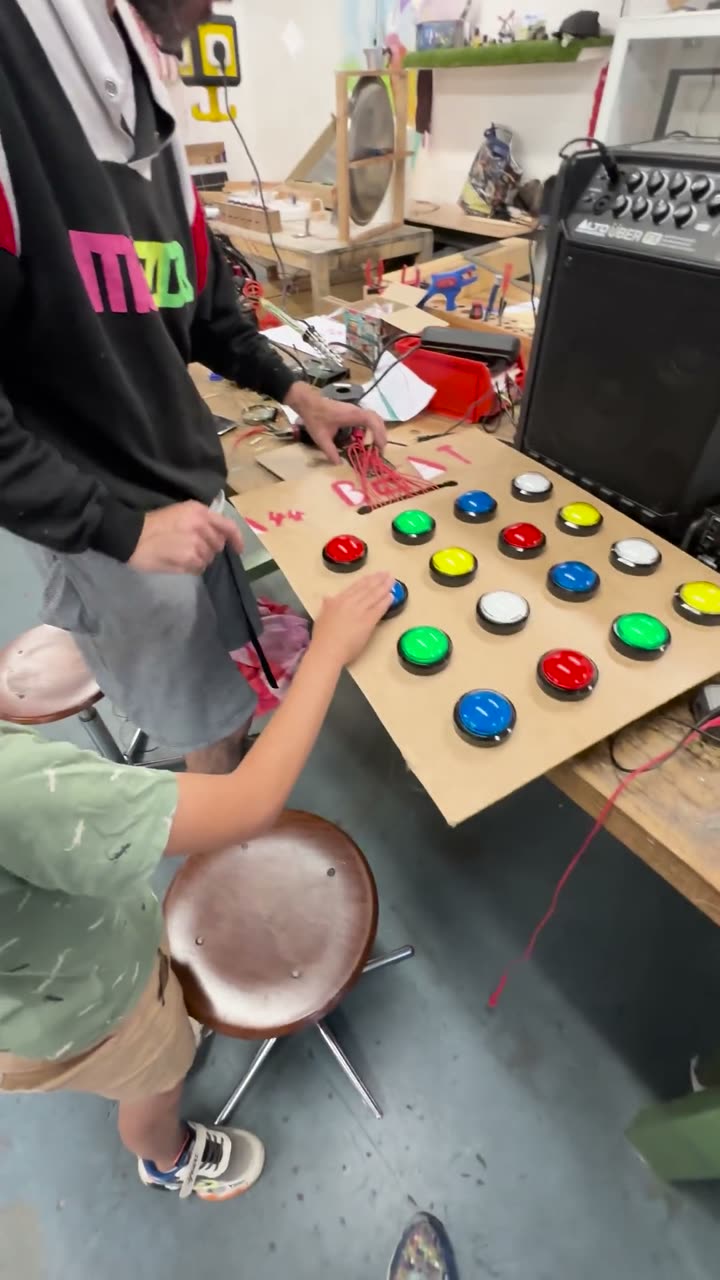
The participants copy nothing, they design: first their own interface on paper, then in cardboard and craft materials. The result is “MANEGE BEAT” — arcade buttons on card, each with a job the children thought up themselves.
More than 20 children and young people took part. Two observations from those afternoons shaped everything that followed: children under eight press everywhere — every press has to produce sound. And the moment a device demands reading, half the group drops out.
Beatmaschine — part 1 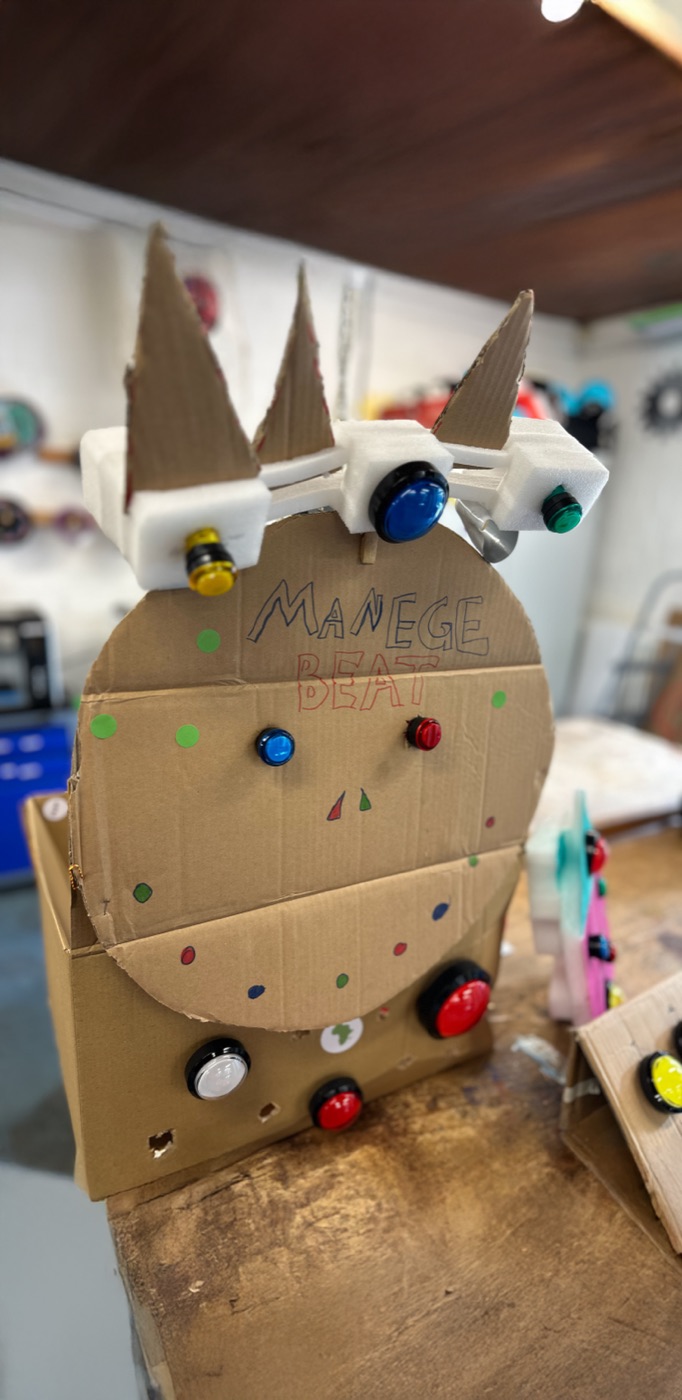
“MANEGE BEAT” -
2025Second workshop phase
Beat Machine 2.0 — the first real prototype
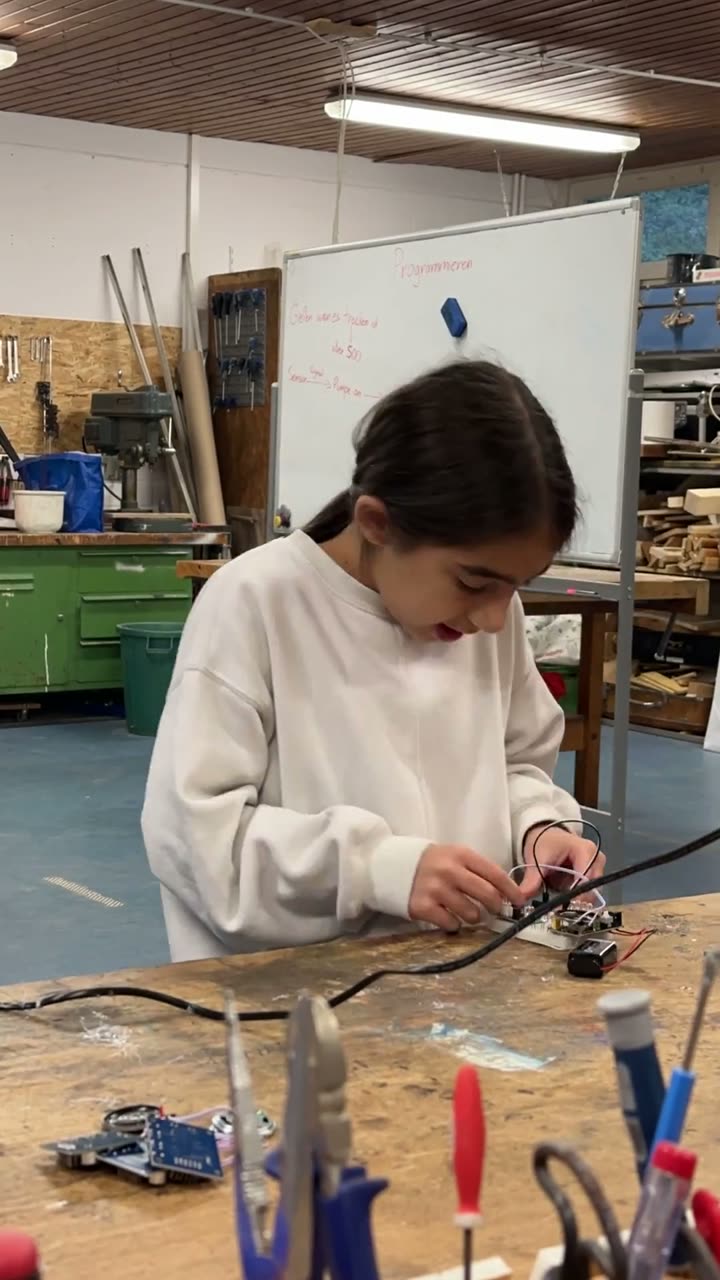
The cardboard model becomes a working device, built on the Pocket Operator by Teenage Engineering, with custom-built RGB buttons. Now there is soldering, wiring and programming.
And the table becomes round: divided into four coloured quarters, each with its own buttons. Nobody has to be told where their place is — the colour says it. A round table has no head.
Beatmaschine 2.0 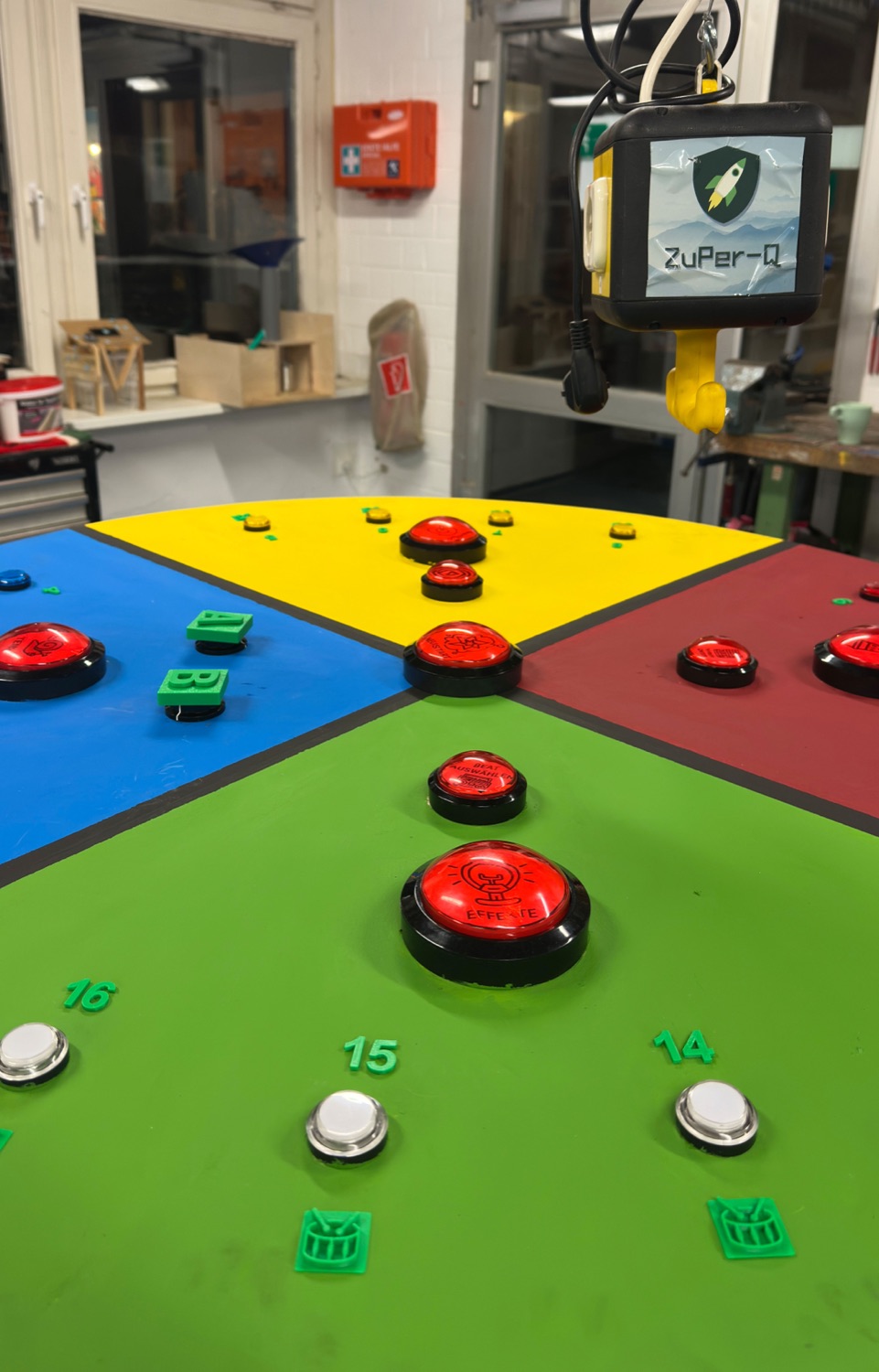
Four colours, four places -
TodayThe instrument
TAMBUM grows out of this
Five round discs on a round table: four voices, and in the middle the master, holding tempo, key and genre together for everyone. Not a word on the display that a child would have to read — and every press sounds.
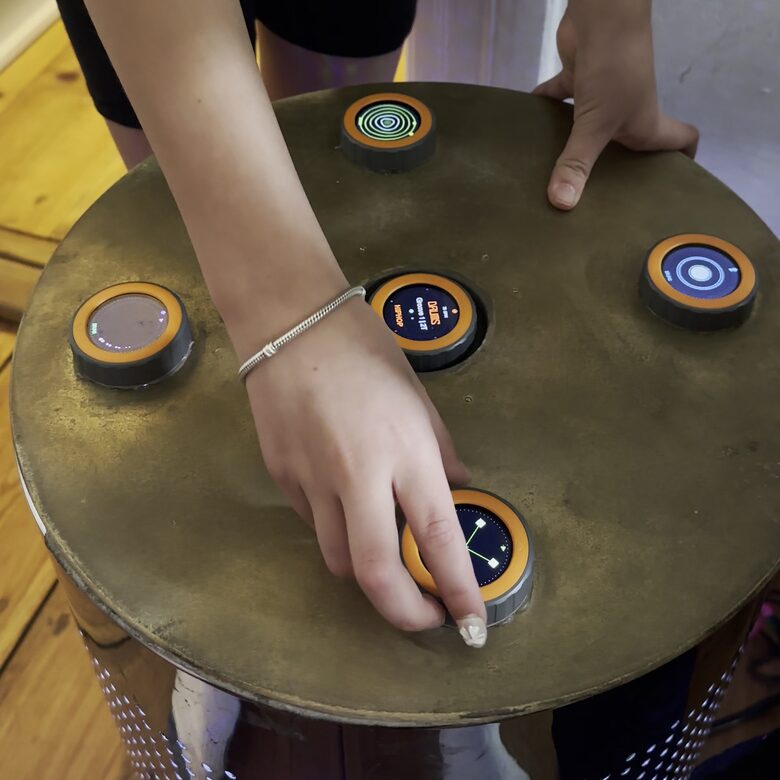
TAMBUM, built The whole table 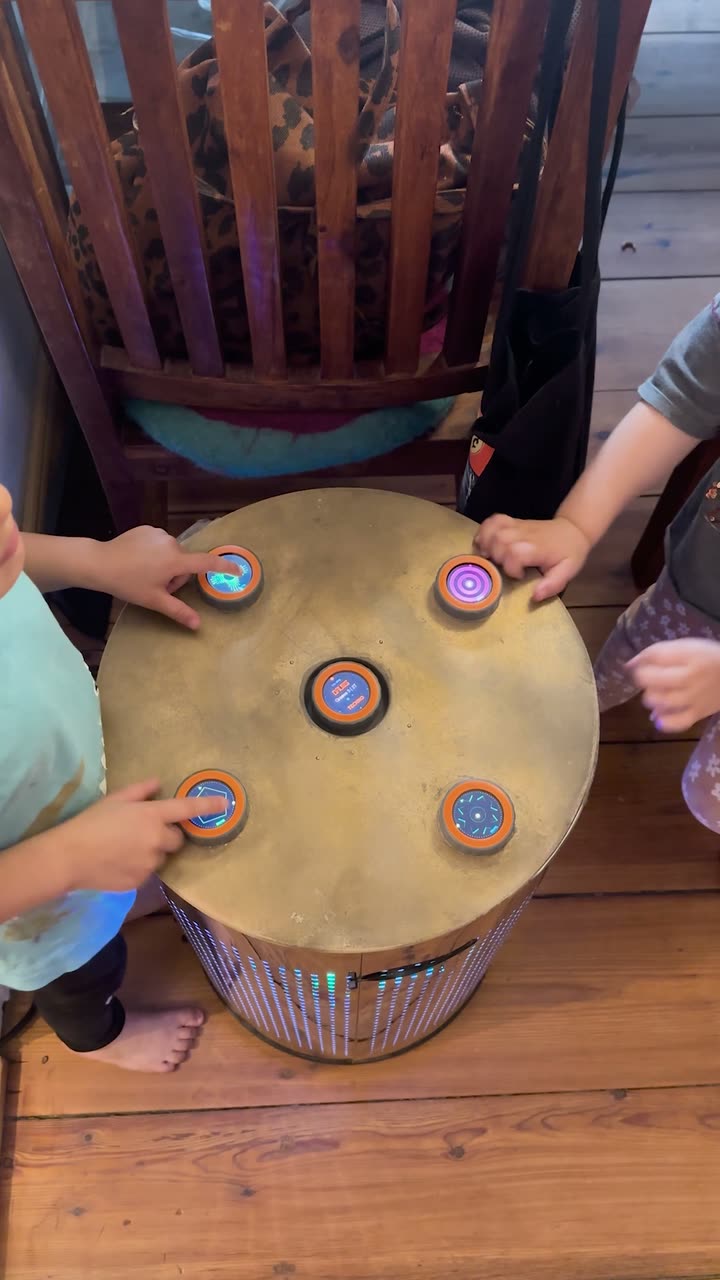
Several children, one table What the films show is not promotional footage. It is the workshop sessions and playing on the finished table, filmed as it happened. The film above sums up what the three below show one at a time.
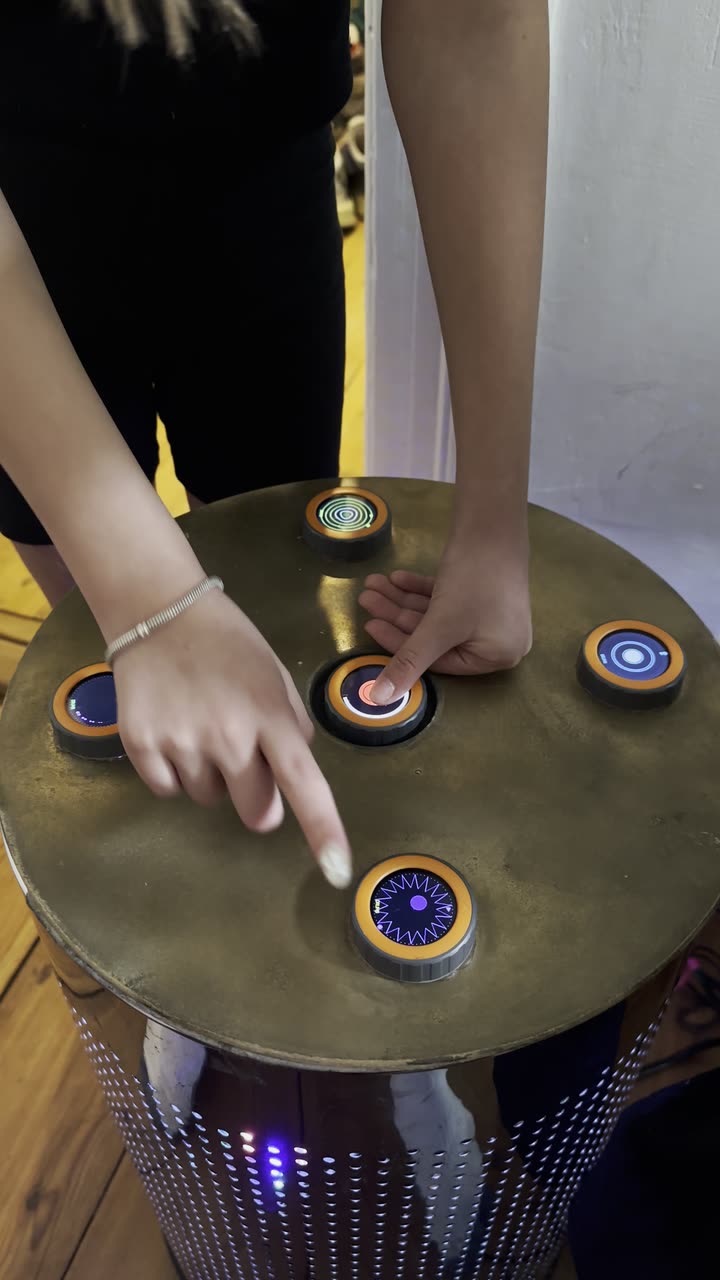
Playing as a pair 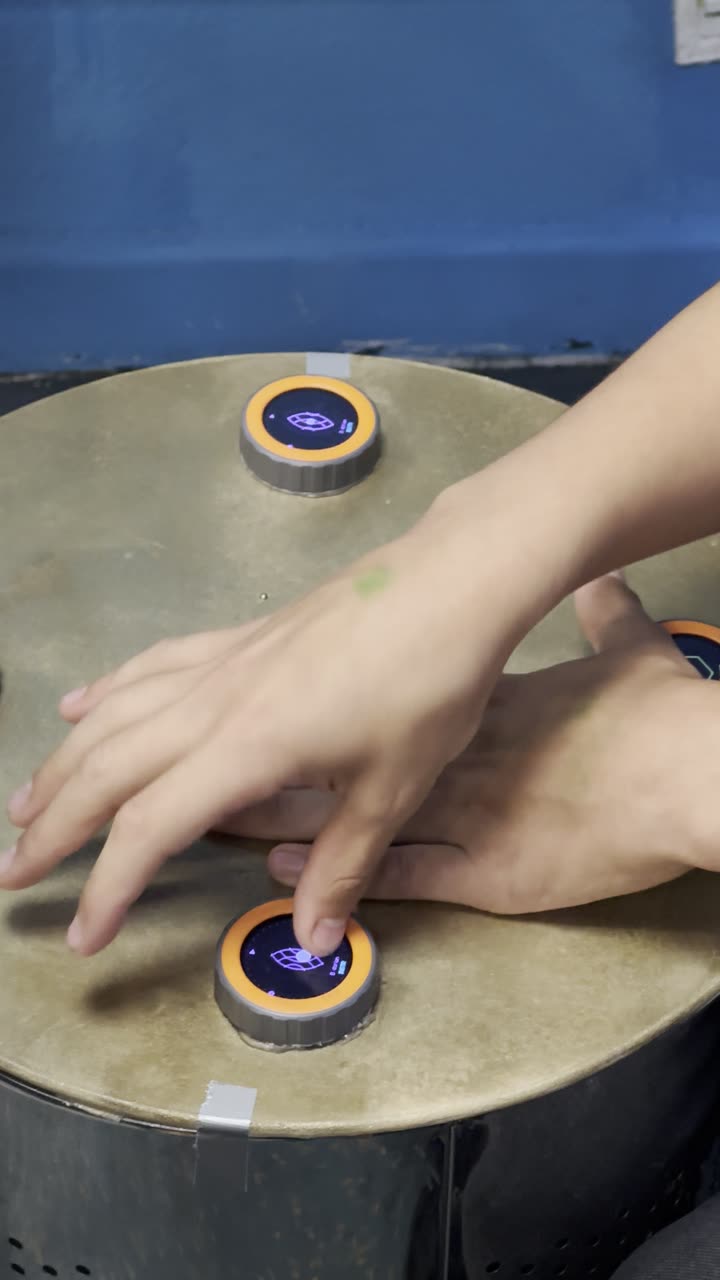
Laying down notes 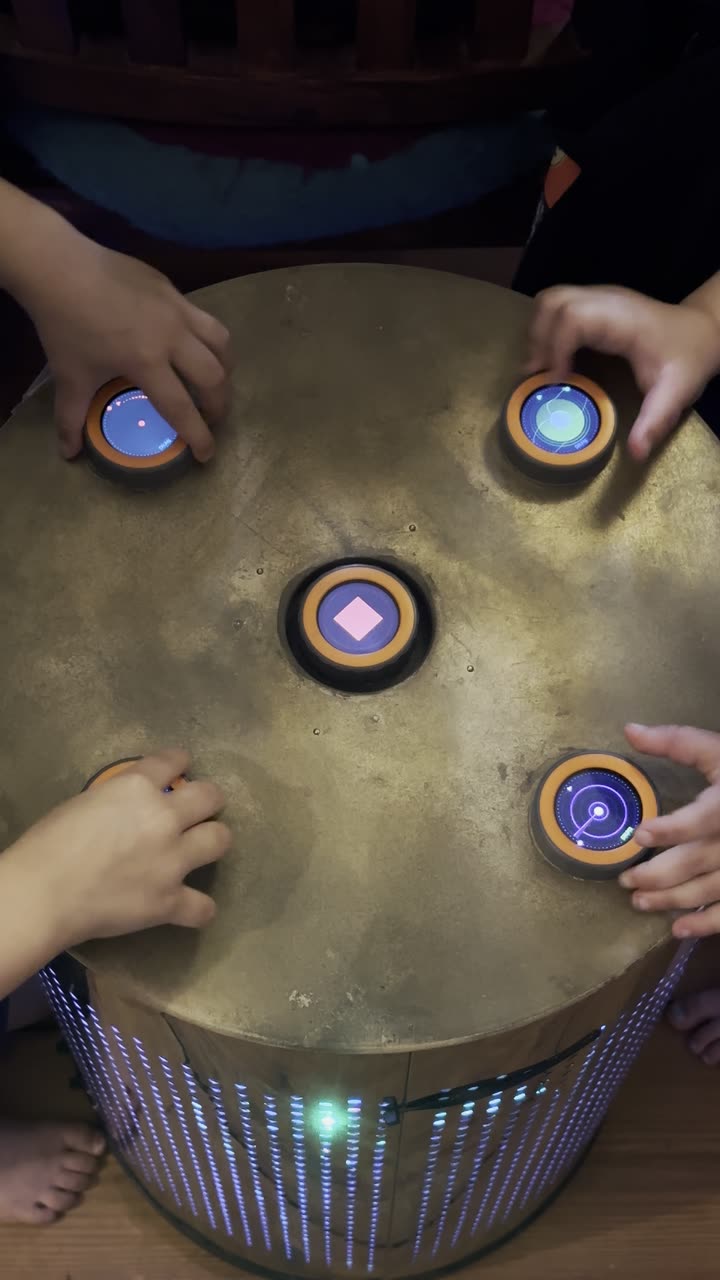
When it gets dark 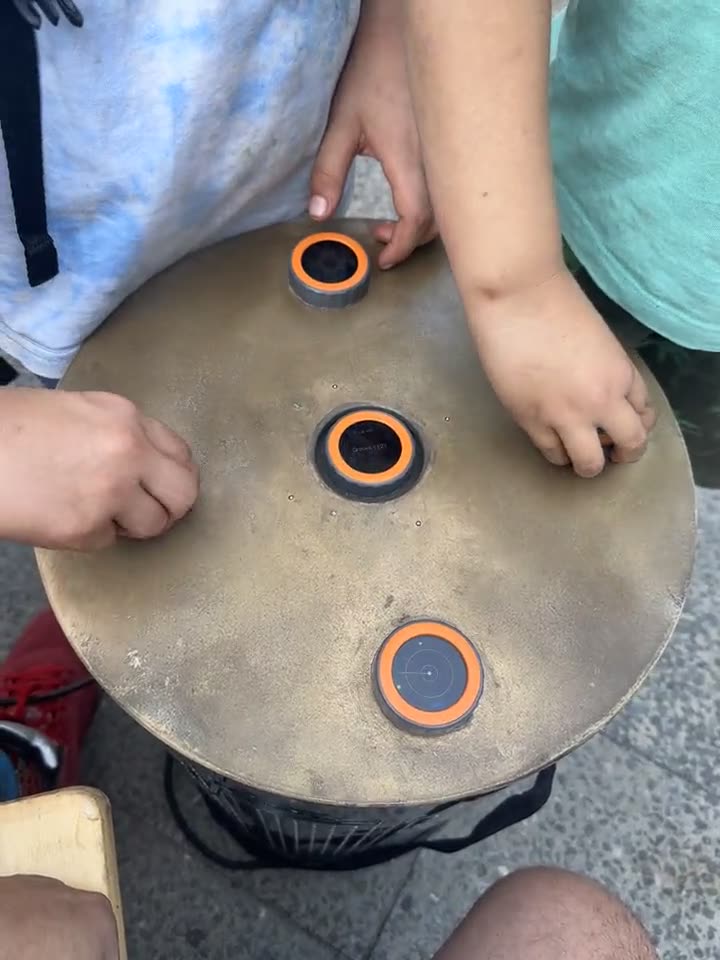
Hands from all sides 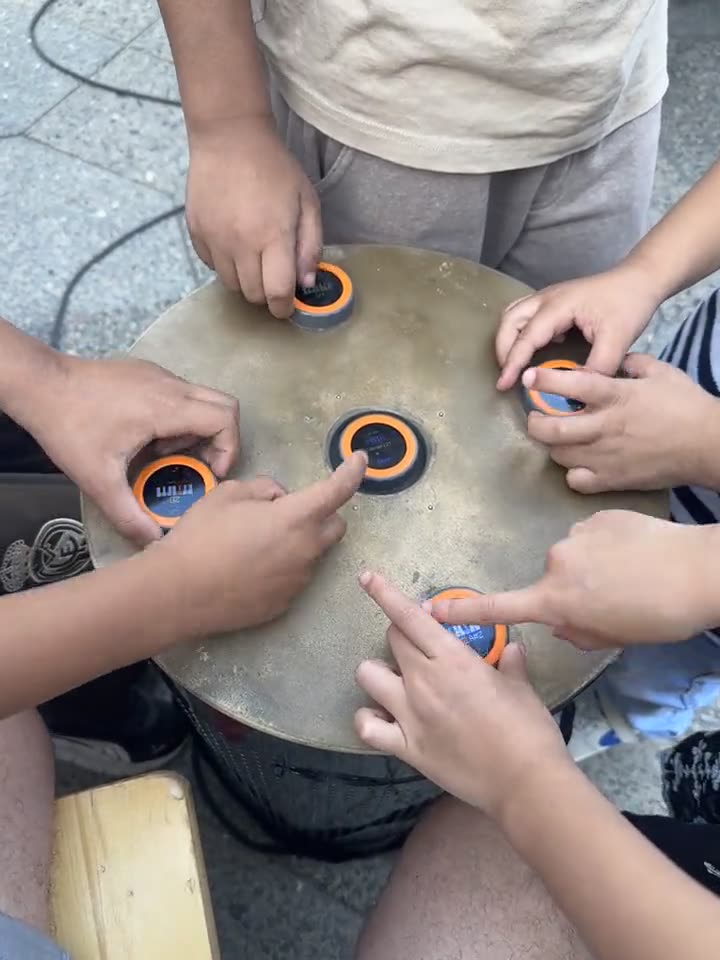
Reaching at the same time 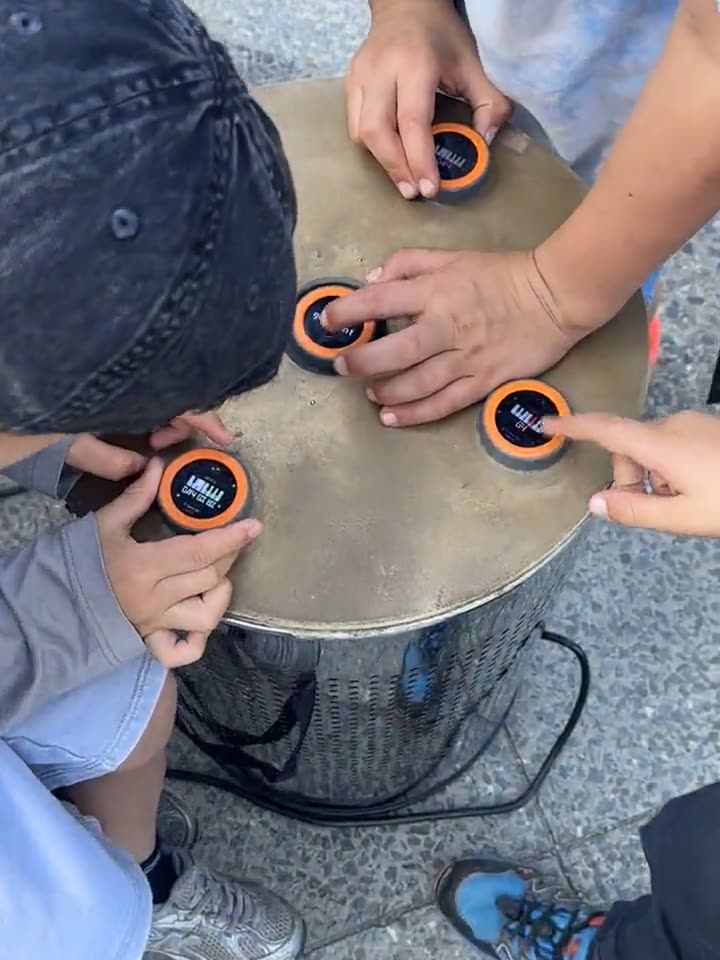
All around the table
From the prototypes to the finished instrument
Tap a photo for the whole storyThe axis continues — drag sideways.
Music connects.
Instruments divide.
That making music together brings children and teenagers closer is well documented. A German longitudinal study of 159 primary school pupils found more mutual liking and more helping in the group after joint music-making. Frankenberg et al. 2016 ↗
But ensemble playing has a precondition. You have to master an instrument, or learn one. Learning means instruction. Instruction means language.
And the tools meant to work without prior training — apps, software, controllers — almost always consist of menus, icons and English words. Anyone who cannot read, or does not know the language, is shut out again.
This project sits exactly in that gap. There is research on music with refugee children. There is research on tangible interfaces in learning. Where the two intersect, there is so far hardly anyone.
Why not simply a piano? That needs no labels either. But it asks for groundwork: 88 keys, of which exactly seven fit the key you are in. Two hands doing different things. Notation — reading again. The first month sounds like practice, not music. A guitar asks for chord shapes on top of that, and they hurt small hands. The reward sits behind weeks of practice — and many give up before they reach it.
TAMBUM puts the reward at the beginning. The very first hit is a finished, good sound — in tempo, in key, on the shared beat, because the master holds everyone together. Tapping and turning is something any hand can do straight away, without force, without fingerings. And playing together does not sit at the end of a long road, as it does with a traditional instrument, but at the start: four children with no previous experience are playing together after a minute — at the same tempo, in the same key. Whoever wants to learn piano or guitar afterwards already knows what for.
An instrument that needs no explanation is not a convenience here. It is the precondition for taking part at all.
The circle turns
four players into an ensemble.
A round table has no head. There is no place better than any other — and that alone changes how children and teenagers play together.
Nobody is at the front
A rectangular table creates a hierarchy at once: whoever sits at the head leads. In a circle every hand is the same distance from the middle knob. Who sets the tempo is agreed between them — not decided by the seat, and no privilege of the adult in the room.
Everyone sees everyone
Who is about to come in shows on the face opposite, not in an announcement. Children and teenagers without a shared language communicate through glances and nods — the circle replaces the words that are missing.
Listening becomes visible
On the other discs the images of their sounds move along. You do not only hear that someone is playing — you see it. That moves the attention from your own hand to the group, and that is where playing together begins.
Why the knobs are round too
A square surface has a reading direction: up, down, left, right. It has to lie the right way round in front of you — stand at an angle and you see it upside down. A round disc has no wrong side. It works the same from every direction, which is why it can sit in the middle of a table with four children standing around it.
The ring around it finishes the thought: Turning has no beginning and no end. You cannot miss and you cannot hit a wall — keep turning and you arrive again. For children who cannot read, that is the difference between trying things out and getting stuck.
What that does to behaviour
The circle gives everyone the same distance to the centre, and with it the same permission. Where nobody is at the front, nobody waits to be picked. That is exactly what you see in the workshops: no queue, no allocation — four hands starting at the same time.
Because every sound falls into the same key and the same bar, after a minute the result sounds like a piece of music. The circle makes the group equal, the instrument makes their playing together audible — that is the point: not “I can do something”, but “we sound good together”.
No words.
Six modes.
Turn the ring.
Five round controls on a round table. Four of them are voices; the one in the middle leads.
There are menus — they just have no words. Six modes hold everything the instrument can do, and they build on one another: first play and record, then effects, tempo, mix, genre. You always carry on working on what you played last. Instead of a label, each mode has its own picture.
What you see here is not a picture — it is the instrument, rebuilt in the browser. The drum sounds are the same filesthat also play on the real table. Try it: tap an outer control, turn the ring, then press and hold the middle one.
The sounds are real: the same recordings that come out of the speakers at the big table. What is rebuilt is the way you play — mouse instead of glass, click instead of a metal ring. And the instrument voices here come from a small in-browser synthesizer; at the real table, Ableton Live takes over.
Sound starts on your first click — browsers only allow audio after a gesture.
Groove grid
Four percussion tracks, four instruments — separate, as in a real kit. The mode you record in decides which row it lands on.
The hardest test:
kids under eight.
The concept wasn't shaped at a desk but on afternoons with children — from what they grasp instantly and what confuses them. Three principles carry it.
One level, nothing to miss
Children under eight press everywhere — so every press makes a sound and never opens a menu. What doesn't exist can't stop anyone: no layers, no settings, no wrong.
What remains is playing. Turning chooses the sound, tapping plays it — that's all anyone needs to know.
Observing instead of guessing
How TAMBUM works is decided in the end by the children and teenagers: where they hesitate, it gets simpler — what they use without being told, stays.
Up next: music games. Small game modes on the same five buttons, turning the shared loop into a shared goal.
Eight genres live in the master — each brings its own tempo, its own sounds and its own effects:
A broad, unhurried beat — plenty of room between the hits.
An even pulse on every beat that carries everyone along.
Straight and mechanical — music from this city.
Wide pads, hardly any drums — for listening closely and calming down.
Fast hi-hats over half tempo — sounds slow yet shimmers.
Bounces and stumbles on purpose — the beat dances by itself.
The hit sits late, the accent between the beats.
The fastest round — rolling drums under a calm bass.
Each genre brings its own tempo and its own sounds — on every change, everything adapts instantly. That is how children learn to tell musical styles apart, and end up producing them themselves.
Playing together.
And along the way: notes.
What children learn here first is playing together — through the hand, not through explanation. Recording a loop means understanding that music runs in rounds. Adding something on top means understanding what a layer is.
At the same time, every puck shows what is sounding: as keys on a piano and with note names in the correct register — C2, for example. The Keys puck shows whole triads right on its display. This is how what you hear connects with what it would be on a piano — and with the names of the individual notes.
And one more thing, which is rarer: you can program instruments yourself. The knobs build on the open-source M5Stack Dial — in a coding workshop, young people learn to program devices like these themselves, with AI tools to help if they want.
Play
Tap, listen, repeat. From the first minute.
Understand
Why does this work together? What happens if I change it?
Change
Your own sounds, your own groove, your own order.
Build
For the older ones: solder, flash, read the code.
How a melody comes together
Recording works note by note: lay down one note, turn the ring one step, put the next one on top. After a few rounds there is a melody — or, on the keys puck, a chord progression. None of it can sound wrong, because only the notes of the selected scale are playable.
The scale is set by the Master: its ring steps through the real circle of fifths, and all four voices follow at once. Whatever is played is always shown on the display — as keys on a keyboard and with note names in the right register. That is how children pick up notes on the side, while playing.
What is the best
interface for children
with no shared language?
That is what this is really about. Not a device you can buy — a question that has no good answer yet.
Every decision in this instrument is an attempt to answer it. Why round and not square? Why a ring instead of buttons? How little text is enough on the screen? These are not matters of taste. Each one can be tested on any given afternoon — on children holding it for the first time.
That is exactly what we are doing in a long-term study: every experience flows straight into the interface and is tested with children again right away. This is made possible by partnerships with the Manege youth club and the Sonnenallee refugee shelter — this year and next, with children who don't yet share a common language.
What comes out of it should not be sales figures, but findings other people can reproduce: which shape is understood, which feedback carries, which gesture everyone grasps immediately.
That is why the hardware is documented openly and the code is kept readable. Anyone facing the same group in Hamburg or Vienna should not have to start from zero — and should be able to object when something is wrong.
An instrument that has to be explained has already answered the question wrongly.
What is being tested
Shape, feedback, mapping. Does a child understand without instruction what happens when they turn it?
How it can be measured
Not by whether it impresses — but by whether four children who cannot talk to each other get something made together.
What stays open
Plenty. Whether the shape holds when the group grows. Whether it works with no adult in the room. Whether it is still interesting the third time round.
Not for sale yet.
But you can play it.
TAMBUM is an experimental setup — there is nothing to order. What there is: Sessions and workshops that we bring along. A session doesn't mean watching, it means playing: after ten minutes the first children have built their own loop. The fee depends on the format — the pure travel and accommodation costs can be calculated below.
- DIY workshop: build your own sampler, including a small soldering exercise
- TAMBUM session — and making music together with the self-built samplers
- To finish, a small performance for the adults
- Setup, supervision throughout, takedown
- Up to three TAMBUMs at once — each is designed for at most four children
Also bookable with one person — the fee depends on the format and is stated in the quote. For schools and youth organisations on a tight budget: ask anyway — for field sites where we may do research, different conditions apply.
- Enquiry via the form below — institution, location, preferred date.
- Reply usually within two working days, with a quote.
- By arrangement about group size, age, room and power. A table and a socket are enough.
- Date — we set up an hour in advance and stay the whole time.
Where we observe as well, a short consent form for photos and video is added — voluntary, and the session works without it.
How a workshop unfolds
Two proven schedules — the times are guidelines and are adapted to timetable and group.
The workshop day can replace an after-school club day — and as a holiday programme it can be extended to a whole week on request.
With up to three TAMBUMs, twelve children play at the same time — rotation is then hardly needed.
Questions
and answers.
The most common questions about the project — answered honestly, measured rather than guessed. Missing yours? write to us.
What is TAMBUM in one sentence?
An electronic ensemble instrument for four children at once: four voices around the edge — bass, chords, pads, melody — and in the middle the master, which sets tempo, key and genre for everyone. You learn to build beats and music on it: pick a sound, record, stack layer on layer, mix. Not through lessons, but because you hear straight away what you just did.
Who is this for?
For groups that should not need a shared language: children without musical training, linguistically mixed classes, open youth work. The toughest test is children under eight — but it works just as well with teenagers and professional audiences.
How many children play at once?
Four at one table — each voice belongs to one hand. At demonstrations up to three tables are possible and the group rotates; that way a whole class gets to the instrument in one workshop day.
Can you buy TAMBUM?
No — TAMBUM is not for sale. What you can book is the demonstration with us: we come, set up and stay with the group. Should that ever change, the newsletter will say so first.
What does a demonstration cost?
The fee depends on the format — solo or as a pair, a compact session or a full workshop day. Travel follows a fixed formula that is stated openly in the enquiry form. There are no hidden items: what the offer says is binding.
One filled-in form is enough — you get a quote covering fee and travel, with no obligation.
What does the room need?
A table, a power socket and some space around it. We bring the pucks, speakers and computer and set up an hour before the start. No internet is needed — everything runs on site.
What is on the table?
Five off-the-shelf rotary displays with round screens, connected to a computer by USB. The base is metal, the top is engineered wood. The knobs build on the open-source M5Stack Dial. The prototype is built and plays. What does not exist yet is a board of our own and a fitted battery.
- Controls
- 5 × M5Stack Dial · ESP32-S3
- Display
- 240 × 240 px, round
- Connection
- USB takes priority, Wi-Fi is built in
- Sound engine
- Ableton Live on a MacBook
How fast does it respond?
Notes go straight from the control to the sound engine. The mediating program only listens in to record — it does not sit in the audio path. Hence the low figure.
- Finger → note
- 1.5 ms
- Frame rate
- 36–43 frames/s
- Switch genre
- milliseconds
- Audio dropouts
- none
What sounds are inside?
Eight genres, each with its own tempo, sounds and effects. Four percussion tracks and four instruments, each track with 64 slots.
- Genres
- Hip-hop 90 · House 124 · Techno 132 · Ambient 70
- Trap 140 · Funk 110 · Reggae 75 · DnB 174
- Tracks
- 4 percussion + 4 instruments
- Sounds per track
- 64
- Sound library
- 429,086 recordings, indexed and searchable
Where do the images on the displays come from?
Every sound has its own image. None of them is a video — all are computed, frame by frame. The same images run at the top of this page.
- Images
- 64 in the firmware
- Memory
- ~600 KB of code instead of several megabytes of video
- When idle
- the image stands still — saving power
- On touch
- shifting · yielding · thickening
What does not exist yet?
For the sake of honesty, because on pages like this plans tend to sound like reality. Housing and prototype do exist — the instrument is built and plays. Still open:
- Battery
- charging circuit present from the factory, not populated
- Loop game
- flow is set, game logic to follow
- Custom board
- planned for later
Request a session.
No contract, no commitment — for now just the question of whether a date works.
The TAMBUM newsletter.
About once a month, and only when there is genuinely something to report: new session dates, progress on the instrument, findings from the classroom — and word when TAMBUM is actually for sale.
Your address is never resold, no third-party advertising, one-click unsubscribe in every email.
After you send this you will get an email with a confirmation link — only then do we send you anything. Every issue carries an unsubscribe link; one click is enough. What we store is set out in the privacy policy.